

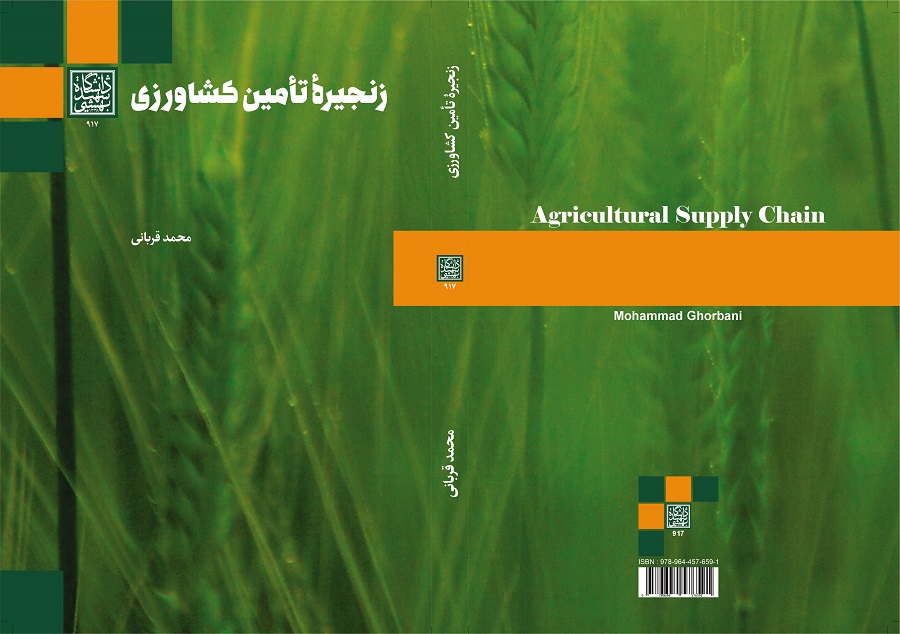
The book Agricultural Supply Chain, authored by Dr. Mohammad Ghorbani, Professor at the Faculty of Earth Sciences at Shahid Beheshti University, has been published. This book was first released in 2025 (1404), in a 362-page royal octavo format, by Shahid Beheshti University Press, and is offered at the price of 3,250,000 Rials.
Agriculture plays a fundamental role in ensuring food security, economic development, and societal sustainability. The rapid transformations in agriculture in the modern era—including technological advancements, shifts in consumption patterns, market globalization, trade exchanges, sanctions and crises, and environmental pressures—have pushed the agricultural sector toward the necessity of redefining and optimizing production and distribution systems. In this context, the agricultural supply chain, as a dynamic, integrated, complex, coordinated, and multidimensional network, and in fact as the key actor in synchronizing agricultural stakeholders (including input suppliers, farmers, processing industries, wholesalers, distributors, retailers, and consumers) to achieve food security, rural economic development, and natural resource sustainability, has become a central focus for policymakers, researchers, and the agricultural industry.
The agricultural supply chain is a critical contemporary need of the agricultural sector and an inseparable component of food security, farmers’ livelihood security, and the trade of agricultural commodities in both the present and future. Beyond the production process itself, it encompasses a wide range of activities from farm to consumer table, organically linking them with a network of agricultural actors. These chains influence the quality and safety of agricultural products, the extent of resource loss, producers’ income levels, consumer satisfaction, and environmental impacts.
The efficiency, sustainability, and resilience of these chains determine their ability to respond to food crises, climate change, and fluctuations in the price and quantity of agricultural products in the market.
Agricultural Supply Chain is presented in ten chapters: Agricultural Supply Chains and Their Rationale; Responsible Agricultural Supply Chains; Resilience in Agricultural Supply Chains; Management of Agricultural Supply Chains; Governance in Agricultural Supply Chains; Financing Agricultural Supply Chains; Ethics in Agricultural Supply Chains; Policies Supporting Agricultural Supply Chains; Smart Agricultural Supply Chains; and Future Agricultural Supply Chains. Across these chapters, an analytical and critical approach is adopted to examine key principles and concepts essential for agricultural actors in practice, as well as the tools and technologies related to agricultural supply chains. Additionally, various sections of the book draw on global experiences and case studies from other countries, alongside a focus on Iran’s agricultural market, to clarify the practical dimensions of these concepts.
This book serves as a scientific resource and valuable reference for students in agricultural disciplines—particularly agricultural economics (specializations in agricultural management and production, agricultural policy and development, and agricultural marketing and trade)—as well as for students of economics, management, marketing, and rural development at the undergraduate, master’s, and doctoral levels. It is also a practical reference for managers, policymakers, and stakeholders in the agricultural sector.
Students and interested readers may purchase the book from the Sales Office of the Scientific Publications Center of Shahid Beheshti University, located on the ground floor of the Information Technology (IT) Building, or place an online order through the Center’s website. The electronic version of the book is also available for purchase on the “Fidibo” and “Taghcheh” platforms.